View Full Version : A reality check on "trail" dies
wavysteps
01-07-2008, 07:07 PM
Every once in a while, you think that a fact or data is nailed down and up pops something to make you question what you have thought to be true.
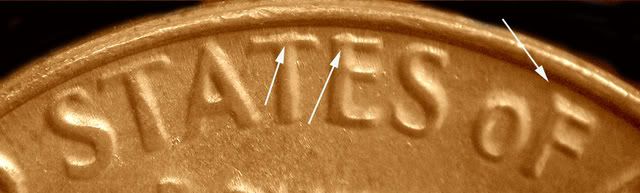
For instance, look at these two pictures:
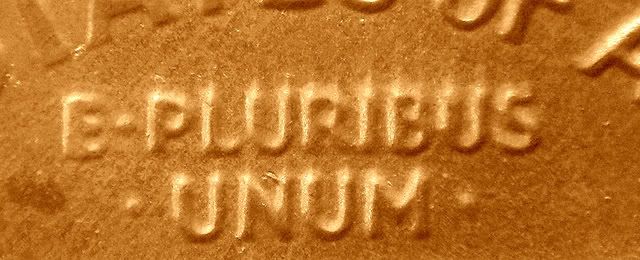
http://i49.photobucket.com/albums/f292/Wavystep2003/IMG_0148.jpg
http://i49.photobucket.com/albums/f292/Wavystep2003/IMG_0145copy.jpg
A typical "trail" die with distortion seen on the tops of the letters in EPU, the T and E of STATES and the word OF. The offset direction is 010 degrees. Actually nothing very special about the die for there are more than one dated Lincoln cent that show just about the same affects.
However, this one is a 1982 Lincoln cent, large date, zinc.
Does this change the story for when the single squeeze process first began? Remember, trail and wavy step dies have been linked to the single squeeze hubbing and have not been encountered with multiple hubbed dies.
What this may indicate is that the MINT was experimenting with this type hubbing long before the printing of their report in 1986. John Wexler has two 1984 Lincoln cent proof dies that show wavy steps and who knows what else is out there as far as dates and their connecting with the trail and wavy step anomalies.
Conclusion from this die; yes, it is a trail die, the earliest known and I still believe that it was produced by the single squeeze hubbing system.
BJ Neff
diamond
01-07-2008, 07:15 PM
I don't think you can safely conclude that the Mint was experimenting with the single-squeeze technique this early. If trails represent die deformation during hubbing, then theoretically this deformation can occur during the first impression in a sequence of multiple hubbings. Perhaps it's simply more likely to occur during a single-squeeze hubbing because of the greater pressures involved.
Regardless, it is a provacative specimen.
wavysteps
01-07-2008, 09:14 PM
We will never no when the U.S. MINT began the single squeeze hubbing program, however, we must keep in mind that the Royal Canadian Mint began using the single squeeze system in 1978, seven years before our MINT made its first mention of it.
Mike you are correct in saying that this could have occurred on the last hubbing of a multi hubbed die and this may very well be the case. Again though, we must look at the previous 23 years of the Memorial design and then the previous 50 years of the Wheat back design for similar occurrences and to this date, there are none.
It is a perplexing situation and hopefully I'll come up with some sort of answer from the sources that I do know.
BJ Neff
BIM Mania
01-07-2008, 09:16 PM
It is a great point all the way around and a good reason to fuel further research.
For the benefit of those not aware, it is important to note that 1982 was the first year that plating Lincoln cent denom's with copper occured. ( The core was zinc composition).
While plating has produced dramatic phenom, like "bubbling", and another, called "Split Line Doubling”, which is a term and phenom Mike D. has explained, it doesn't cover everything. It would seem natural that you would be, (and others, including me), be exploring these much earlier dates.
Perhaps early dated Linclons with this plating experienced phenom yet to be revealed. Maybe now more info will filter in, bringing unexpected and supportive information on what you suggest.
Anything is possible, and ain't it wonderful?
Jeff
Rhubarb
01-08-2008, 10:36 PM
I am new to this forum and my opinion doesn't have any weight on what is or what isn't.
My opinion by looking at the coin it is wavysteps. Who has the final say- so on a new find or opinion about a coin?
Rhubarb
diamond
01-08-2008, 11:33 PM
I agree with BJ that the coin is showing trails, not wavy steps, while accepting that the two phenomena are closely related or manifestations of the same underlying process.
As far as who has the final say -- nobody does. No opinion carries any more weight as a result of who is expressing it. The credibility of an opinion should always rest on the quality of the evidence and the logical consistency of the argument that ties that evidence together.
wavysteps
01-08-2008, 11:34 PM
Hi Rhubarb and welcome to the CONECA forum.
Opinions in a forum carry as much weight as the next, that is what is great about these things. Everyone who looks at the post forms their own opinion on what it is or isn't and is free to arrive at their own conclusions.
As far as experts in this forum, we do have a few. Mike Diamond is well known for his knowledge concerning mint errors. James Wiles and Ken Potter are well known experts in the field of doubled dies and RPMs. People like Rick Snow, J. T. Stanton, Bill Fivaz, Jose' Cortez, just to name a few experts in various fields, do visit this site. So we do have a very wide range of knowledge.
As for this post, you happened to hit my field of interest. In a way, "yes", you can call this a wavy step of sorts, except the extensions are in the wrong direction. If we were to reverse the die movement 180 degrees, the extension would in fact affect the stairs and stylobate of the Memorial building. However, with the direction taken, it is considered a trail die and also the earliest to date since it occurred ion a 1982 Lincoln cent die.
BJ Neff
wavysteps
01-22-2008, 10:25 AM
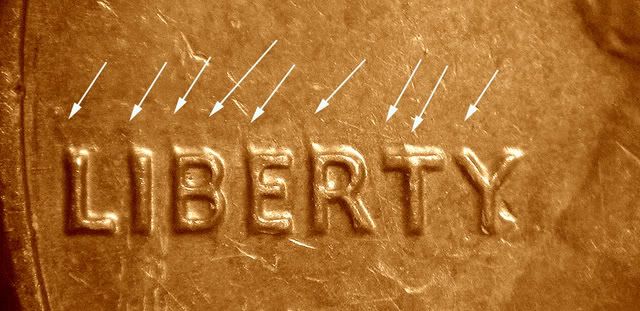
My good friend, Bill Slaughter, sent me the latest in surprises concerning trails and wavy steps.
http://i49.photobucket.com/albums/f292/Wavystep2003/IMG_0202copy.jpg
You can describe this trail die as a run of the mill obverse die with moderate trails from the word LIBERTY, with an offset direction of 350 degrees. The big surprise is that it is from 1983, out of the Denver Mint. That makes it the earliest know obverse trail die.
While this die seems to be a bit before our thought of when the MINT began experimenting with the single squeeze hubbing, it still may fall in that time period. Enquirers as to when the MINT did actually beginning the experimentation with single squeeze hubbing have been placed.
BJ Neff
diamond
01-22-2008, 10:49 AM
Fascinating. I wonder how far back this phenomenon goes.
vBulletin® v3.7.2, Copyright ©2000-2009, Jelsoft Enterprises Ltd.