
 Tweet
Tweet
The clubs Variety Mater Listings do not show repunched dates or letters. Is there somewhere that we can find these? I have a 41S and 44 Washington quarter(s) that I believe have RPD's. I do have cherrypickers guide, but it doesnt show them. Thanks.
-
-
Many people will tell you that the re-punched date ceased with the Indian Head Penny. This is correct, however, there is a possibility of a re-punched digit.
We must remember that it was the practice of the MINT to use the previous year's master hub for the next year. This was done by abrading the last two digits of the date from the master hub, making a master die, punching in the those new year last two digits and then making a new master hub for that year. Like the re-punched mint mark, there was a possibility that when the last two digits were placed into the master die, there may have been a slip causing some doubling of that particular digit. This would show on all working dies since it happened on the master die.
Then there is the case of the 1946 Lincoln cent with its weak last two digits. I did an article in ERRORSCOPE detailing the possibilities that some of the working dies were strengthened by re-punching those last two weak digits.
In all the above cases, this would be considered a re-punched digit, which is different in nature than a re-punched date. Also, the re-punched digit is an arguable circumstance for many believe that the doubling of these digits is due to hub doubling.
BJ NeffMember of: ANA, CCC, CONECA, Fly-in-club, FUN, NLG & T.E.V.E.C. -
There's a 1956 (or 1956-D) cent with an alleged repunched "5", and a 1957 (or 1957-D) cent with an alleged repunched "7". Some folks think that these were blundered master dies that were then re-used as working dies. Having dealt personally with one of these, I am doubtful it's a repunched digit at all.Mike Diamond. Error coin writer and researcher.Comment
-
BJ is correct in his analysis. I list these "repunched digits" as class VII master die doubled obverses. Mike, which of the two you mentioned have you studied. I have not seen the 1957, but pictures don't convince me it is anything more than a light die gouge. I am considering removing the 1956 from the files as a die gouge and not a blundered master die.CONECA 20th Century Die Variety AttributerComment
-
I'm pretty sure it was the one from 1956, but I'd have to dig it out to make sure.Mike Diamond. Error coin writer and researcher.Comment
-
Re: Repunched date.
Thank you gentlemen for your always informative and educational discussions.
We are all at different stages on our road to enlightenment. Thanks for your dedication, patience and expertise.Comment
-
James - I must agree with you on the case of the 1956-D with rotated secondary 5 digit. While this anomaly does have the appearances of the top part of the 5 digit, I question why there is none of the bottom of that secondary digit showing.
I am sure that you remember this die that appears to be a wayward mint mark, that was a bit to small to be such
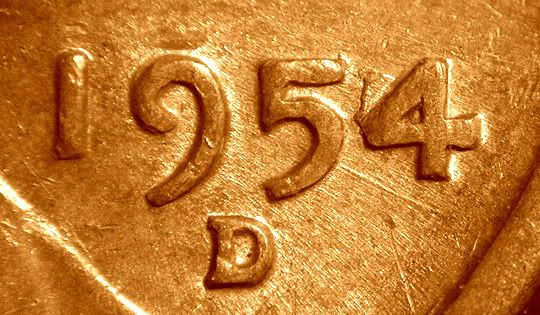
If you will, compare it to the 1956-D die in question and notice the similarity in shape and tilt to the anomaly on the 1954-D die.
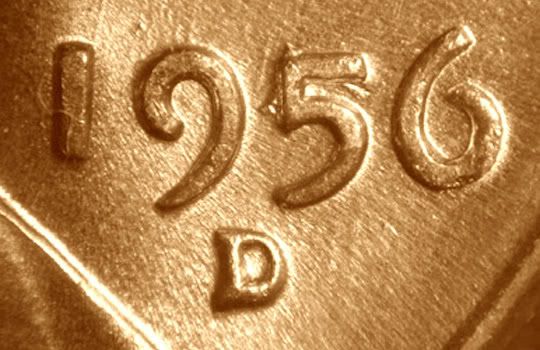
It is probably just an odd coincident, however, it does make one stop and think if there is some sort of correlation between the two marks.
BJ NeffMember of: ANA, CCC, CONECA, Fly-in-club, FUN, NLG & T.E.V.E.C.Comment
-
Interesting comparison. Thanks, BJ.Mike Diamond. Error coin writer and researcher.Comment
-
According to David lange and others, the digits were not punched but engraved the days of actually repunching digits ended in 1917 as the older series of coins was phased out.
The digits were hand engraved in the style of the remaining digits. If they were engraved, there can not be repuncched digits.Comment
-
I am not to sure what you are implying. Are you saying that once the last two digits were abraded from the previous year's master hub and a new master die made, that the digits were engraved into that master die?
BJ NeffMember of: ANA, CCC, CONECA, Fly-in-club, FUN, NLG & T.E.V.E.C.Comment
-
Thats precisely what is meant by David. A master hub is ground down to remove the digit or digits needing replacement. A die is then made from that hub creating a master die with the digits missing.
The digits were then hand engraved into that die in the style dictated by the previous years design. That die then became the master die for that years production.
That master die was used to produce all working hubs which in turn were used to create all working dies. Digits were not repunched with digits after 1917 as the older series of coins were phased out. All new designs such as the Buffalo nickel, Winged Liberty Dime, Standing Liberty Quarter, Walking Half and Lincoln cent had the date as part of the initial plaster model from which the original galvano was created. The master hub produced by the galvano was the one changed each year unless a need for a major change came into play such as the new version of the Standing Liberty Quarter.
So, no repunching of digits, only hand engraving, No repunching means no repunched digits (No repunched dates). There may be a slip of the hand when engraving takes place causing some unusual characteristics here and there but they are not repunched digits simply due to the nature of adding dates (by engraving) to the master hub at the time.
I was in a discussion on this in another forum and David and I have corresponded back and forth and as of 2008, this is the accepted method of dates being added to all U.S. coins of the period.
Some minor differences came about in the 1980s as digits were changed on new plaster models and not on the galvanos. Still, each master hub had four digit dates that transferred to master dies.
I am sorry that can't respond more quickly to each post as questions come up, we are bound by the forum rules and each post needs to be approved. That tends to slow down the discourse a bit.
This is one of the major reasons why some things like the 1958 over 1957 Lincoln cent was debunked.
Over dates such as the 1918 over 1917 D Buffalo nickel or the 1918 over 1917 S Standing Lib. Quarter or coins like the 1942 over 1941 (P+D) are considered doubled dies as two different dated hubs were used to create the dies. There was no repunching of digits or dates and when looking at those coins, it is plain to see that different hubs were involved. Indeed many researchers have come to this conclusion based upon the study of how dates were added to dies starting in 1907, actually. Again by 1917, punching dates into dies was a thing of the past.
Thanks,
BillComment
-
Just a quick note, The US Mint in Philly was still known to repunch digits into dies for coins we made for the Philippines but not our regular issue coinage as described in the previous post.
Thanks,
BillComment
-
May I ask exactly where this information originated from? I have heard that the early U.S. coins were all hand engraved, including dates, however, modern coins (post 1900) used punches for both lettering and digits.
In his book "Mint Errors" Alan Herbert refers to the days of hand engraving being replaced by the punch letter and digit. Having accomplished a study on the Lincoln cent series, I would find it very hard to fathom how year after year a precise digit could be replicated by hand engraving, especially in a steel die, even if it is soft steel.
While I do imagine that micro engraving can be accomplished, the MINT was and is still interested in the fastest, most economical way of producing a die, where it be a master or a working die. To have an engraver match the exact replication of a previously used digit or letter, making it the exact depth and width would take countless hours when compared to a punched in digit or letter. I am sure that David Lange and others are knowledgeable concerning aspects of die making, however, on this point I will disagree. I can not see the MINT reversing their strategy and going back to a method so time consuming.
BJ NeffMember of: ANA, CCC, CONECA, Fly-in-club, FUN, NLG & T.E.V.E.C.Comment
-
Hi BJ,
From a series of articles in the NUMISMATIST, the magazine for the American Numismatic Association, December 2007 edition, pg 23, "Dancing With Dates, Part 1" where David Lange states the following.
I quote:
"With the introduction of the Saint-Gaudens gold eagles ($10) and double eagles ($20) in 1907, the date was included in the artists sculpted model. It was transferred mechanically through the various stages of die preparation so that all working dies carried dates of identical size, style and position. When preparing the next year's dies, the engraver would grind the obsolete numerals off the hub, sink a new die from the altered hub and then hand-engrave the new numerals into it, mimicking the size and style created by the sculptor. This became the master die for that year, and all working hubs and dies were generated from it."
David Continues:
"This technique was applied only to new designs as they were introduced, so existing series such as the Liberty Head nickel and Barber silver coins did not have sculpted dates." "By 1917, the technique of punching dates became a thing of the past for regular issue, U.S. coins, though it survived for years afterward on some of the Mint's other coinage, such as that produced for the Philippines."
This is some of what I've (Bill O') found that backs this theory up.
This is a link to a picture St.Gauden's, Plaster that was his idea for a U.S. cent. Notice the full date. That was the practice at the time for coins that would be newly designed. Keep in mind that it was for new designs, so there are repunched dates on Indian Head cents, for example up until around 1908.
In articles printed in The Numismatist, January, February and March as continuations of the series with respect to other denominations, Lange describes the methods of engraving the digits as needed into the master die.
In an email to me David states pertaining to Lincoln cents:
"The plaster, galvano and master obverse hub included all four numerals, as sculpted by Brenner. The final two numerals would have been ground off the hub for 1910's coinage, a new master die sunken from it, and the numerals 10 added by hand engraving into the master die. These numerals were hand engraved each year afterward until a new master hub was created in 1916 having sharper features. The same process for altering dates occurred each year until 1920, when the second 1 was also ground away. There's nothing to indicate that the first two numerals 19 were ever altered until adoption of an entirely new obverse hub in 1969.
Since 1969 there have been frequent changes, with the Mint evidently creating entirely new master hubs each year since the late 1980s. On these later coins the dates are probably sculpted at the negative plaster stage, though computer graphics technology and laser cutting has made it possible to do almost everything without the artist getting his hands wet."
and....he adds in a subsequent email:
"You may add to your discussion that the punching of dates into individual working dies appears to have been last performed in 1908, and then with three- or four-digit punches. Complete dates were punched into the master dies for each year thereafter for existing coin types, while all new coin types commencing with the 1907 gold issues had sculpted dates that were altered only as needed each year through hand engraving into the master die."
Further evidence of the practice, I understand can be found in Breen's Encyclopedia ( I am not a big fan but it seems he had this right) where he makes note of the 1918 over 1917 S Standing Liberty quarter. In that listing he describes how two hubs with full dates were used to create a master die. Breen States: "One working die received a blow from a 1917 hub, routinely went to the annealing furnaces to be prepared for subsequent blows, but through error or intention, returned to the wrong press and received its other blow from a 1918 hub."
That would not have happened if they were only repunching digits.
Variety specialists know that It is the same with the 1914 over 1913 examples of the buffalo nickels. They are known for S and P issues. I am not sure if a Denver Mint example has been discovered yet. Anyway, two different full date hubs were used as the root of the problem.
This is my own observation after looking at nearly 5,000,000 Lincoln cents and millions of coins of other denominations in my time. If digits were indeed punched into dies, There would have to many examples of digits out of place or turned, or noticeably overlapped such as it is with Repunched Mintmarks. There are none. It doesn't exist.
I think the premise of the Mint trying to be cost effective and efficient is mythical. The fact is that many designs and patterns were created, plasters made, galvanos made , master hubs made, and master dies made That were all scrapped. Some were scrapped in short order. The 1917 replacement of the Standing Liberty Quarter comes to mind. The Mint, a government entity at the time was far from efficient or cost effective.
Another example of something that is pretty common knowledge amongst variety specialists:
The Mint purchased a new Janvier Reducing Lathe in 1907, but didn't actually use it successfully until late in 1920. The new machine was capable of reducing in size a model design of approximately 12 to 16 inches in size (what is called a Galvano) to the exact size of a die needed to strike the actual coin.
The Mint first tried the direct reduction in 1907 on Augustus St. Gaudens' new $20 Double Eagle design. Due to unknown technical problems, they were unable To do it. It seemed the Mint could not get the Janvier to operate properly and correctly and satisfactorily cut on a direct reduction from a larger-size Galvano. They scrapped the direct reduction process and fell back to a compromise position.
As a consequence, Brenner's Lincoln Cent, Frasier's Buffalo Nickel, Weinman's Winged Liberty Head Dime, and Macneil's Standing Liberty Quarter (to name a few) were all reduced outside the Mint to a more manageable 9 inch size by the Medallic Art Company located in New York, NY
None of that is very cost efficient.
The Mint did hire expert engravers. They were expert at re-engraving dies. A gentelman named Edgar Steever, for example was a master engraver working at the Mint until he was in his late seventies. Noone could suggest that he could not artistically render digits by engraving them.
Finally, it is interesting to note that there are no repunched dates in the Indian head cent series for 1909 while there are hundreds of them for years prior. There are also no confirmed repunched dates in any series of U.S. coins after 1909. All are examples of Class III Doubled Dies (Design Hub Doubling) where dies were created using different hubs with different dates.
I can't imagine David Lange going to press with information that he has not thoroughly researched. I do not have his sources, so you may want to ask him what he has used to determine how the process was done. My money's on him though as being correct.
Thanks,
BillComment
-
Hi BJ,
Just another quick note. When Alan Herbert refers to hand engraving moving on to punching digits in by hand, he's talking the late 1700s coming into the 1800s. I think it was 1835 or so when they started using digit punches and multiple digit punches for dates on a regular basis.
Thanks,
BillComment


Comment