View Full Version : Foreign Doubled Dies
Daniel
08-19-2007, 10:15 AM
Hello,
I'm Daniel from Germany, ECIE: dani200105, ebay: laboraffe03.
I'd like to open this thread for foreign doubled dies and i'd like to invite you to post your pix :)
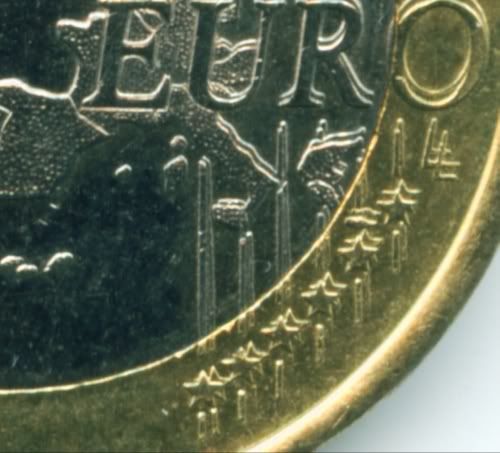
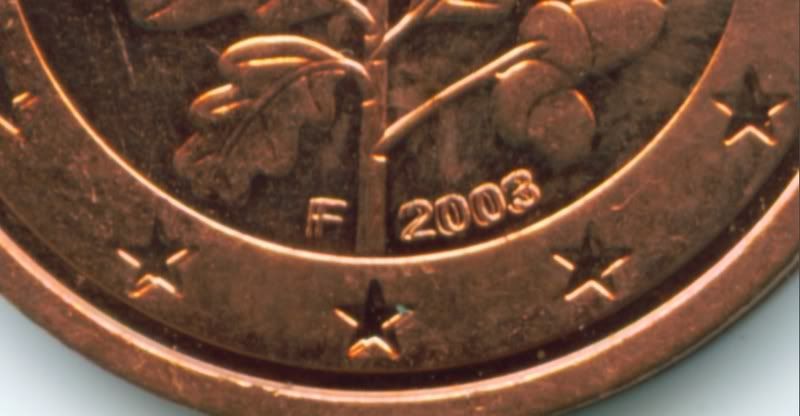
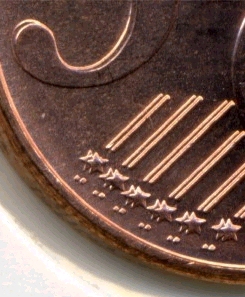
I'd like to start with three outstanding Euro doubled dies:
1 Euro 2002 G
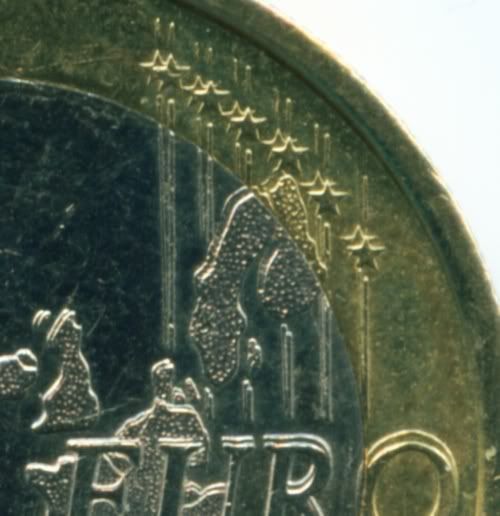
http://i19.photobucket.com/albums/b165/DaniSchneider/1eDDa.jpghttp://i19.photobucket.com/albums/b165/DaniSchneider/1eDDb.jpg
2 Cent 2003 F
http://i19.photobucket.com/albums/b165/DaniSchneider/2cdd.jpg
5 Cent 2002 D
http://www.errorcoins.eu/DD2.jpghttp://www.errorcoins.eu/DD3.jpg
Thanks,
Daniel Schneider
diamond
08-19-2007, 10:23 AM
Welcome to the forum, Daniel. I've enjoyed your posts in the Error Coin Information Exchange, and I'm sure the members of this forum will enjoy them just as much.
wavysteps
08-19-2007, 11:08 AM
Daniel - I thank you for posting those pictures. They are excellent doubled dies. Do you have any idea to what type hubbing ssytem was used for these anomalies? It would be interesting to know if these were a product of the single squeeeze type hubbing system or if they were produced by multiple hubbing.
Thank you and welcome to this forum!!!!
BJ Neff
Daniel
08-19-2007, 11:46 AM
i'm not quite sure BJ but i think for the Euros they use the single squeeeze hubbing system.
diamond
08-19-2007, 02:36 PM
I'd be shocked if this amount of separation was produced by the single-squeeze method. Of course, we see dramatic separation in some of the Minnesota doubled dies. But these involve very localized doubling, not wholesale doubling as seen on these Euros and fractional Euros.
foundinrolls
08-20-2007, 06:12 PM
FROM REPUBLICAhttp://www.foundinrolls.com/images/cu/rep3.jpghttp://www.foundinrolls.com/images/cu/e.jpg
A Closeup of the E in REPUBLICA
foundinrolls
08-20-2007, 06:23 PM
Daniel,
GREAT EURO Doubled Dies!!!
Bill
foundinrolls
08-21-2007, 01:19 AM
Unfortunately, the coin is a clunker but the doubling is easy to spot.http://www.foundinrolls.com/images/cu/1931a.jpg
http://www.foundinrolls.com/images/cu/5tavoa.jpg
Daniel
08-21-2007, 11:07 AM
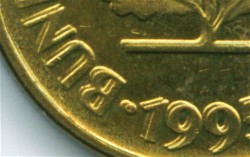
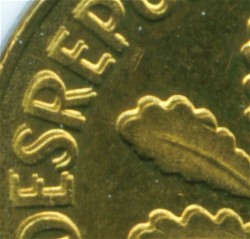
5 Pfennig 1995 F
http://www.errorcoins.eu/5pf_DD1.jpg http://www.errorcoins.eu/5pf_DD3.jpg
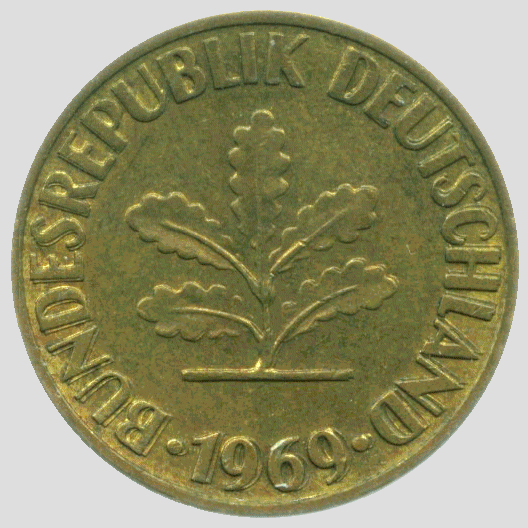
10 Pfennig 1969 F
http://www.errorcoins.eu/doubledied%2010%20pfennig1969%20G.gif
foundinrolls
08-21-2007, 03:27 PM
http://www.foundinrolls.com/images/cu/shil6.JPG
foundinrolls
09-17-2007, 12:29 AM
http://www.foundinrolls.com/images/cu/deoro.jpg
Seeindubl
10-15-2007, 02:25 AM
I believe foundinrolls and I have the same 1986 Un Sucre from Ecuador.
russellhome
12-23-2007, 07:57 PM
For lack of US coins to search, I finally got around to searching my foreign coin collection that I've had for a few decades. I made a nice DDO find on a German 1914 J 1 Mark coin. The extremely fine detail on this one makes for a great doubled die. There are more notches and separation lines than on just about any DD I've seen. About two-thirds of the coin shows nice doubling -- and the rest is nearly normal.
http://www.idsimis.com/photos2/ger1914_1mrk_dd05.jpg
http://www.idsimis.com/photos2/ger1914_1mrk_dd04.jpg
http://www.idsimis.com/photos2/ger1914_1mrk_dd01.jpg
Look at those double claws!
http://www.idsimis.com/photos2/ger1914_1mrk_dd02.jpg
http://www.idsimis.com/photos2/ger1914_1mrk_dd03.jpg
russellhome
02-10-2008, 12:36 AM
I picked up a couple more old German doubled dies. The first is a 1939D 10 ReichsPfennig and the second is a 1939D 1 reichsPfennig.
http://www.idsimis.com/photos2/ger1939_10rf_ddr01.jpg
http://www.idsimis.com/photos2/ger1939_10rf_ddr02.jpg
http://www.idsimis.com/photos2/ger1939_10rf_ddr03.jpg
http://www.idsimis.com/photos2/ger1939_1rf_ddo01.jpg
http://www.idsimis.com/photos2/ger1939_1rf_ddo02.jpg
wavysteps
02-10-2008, 09:16 AM
Ken - as per usual, some great pictures of excellent varieties. Well done.
BJ Neff
russellhome
03-21-2008, 12:52 AM
I found another Nazi era doubled die coin - a bold DDO and a minor DDR. So far, just about every German DD I've found has come from the Munich (D) mint. It appears they had some pretty sloppy press equipment. This one rivals some of those bold Brazilian DDs - having a strong separation for 3 clear and distinct hubbings.
http://www.idsimis.com/photos2/ger1939_2mrk_ddo01.jpg
http://www.idsimis.com/photos2/ger1939_2mrk_ddo02.jpg
http://www.idsimis.com/photos2/ger1939_2mrk_ddo03.jpg
http://www.idsimis.com/photos2/ger1939_2mrk_ddo04.jpg
http://www.idsimis.com/photos2/ger1939_2mrk_ddo05.jpg
http://www.idsimis.com/photos2/ger1939_2mrk_ddo06.jpg
Note: I collect doubled dies and error coins - and these happen to come from Germany and were minted during NAZI era. With these posts, in no way to I intend to promote the politics and ideology of the Nazi regime. I do understand the history - and when I hold a NAZI coin in my hand it does stir up thoughts and ideas that other foreign coins do not. It reminds me that we all need to beware that government can change drastically for the worse and almost overnight. All U.S. coins are enscribed with the word LIBERTY and I pray that the spirit of this idea is never lost in our own ever-changing government.
wavysteps
03-21-2008, 01:21 AM
Ken - I am sure that all of us feel the way that you do and I for one value our freedom that we enjoy in this great nation.
I thank you for making that statement.
BJ Neff
foundinrolls
03-21-2008, 03:48 PM
I believe foundinrolls and I have the same 1986 Un Sucre from Ecuador.
I do indeed have one of these and Seeindubl has a great memory:-) or the info is in her ;-) files:-)
Also,
I must apologize for the fact that my picture of the UN SOL D'ORO that was a doubled die that I had in the first post was lost during a server switch. If I can find another copy of the picture on my computer, I'll replace it:-)
Russellhome, I know that I understand completely. The ideology behind the governments that Minted the coins doesn't even enter my mind when I see a great variety:-) Thanks for posting the pics, they are excellent and educational.
Have Fun,
Bill
Seeindubl
03-22-2008, 12:28 AM
Hi Foundinrolls, actually I posted my coin after joining and at that point your image was still there. I guess it was removed shortly after. And it would be "her" you are referring to:) and known on other forums as "daggit". Nice to meet you.
Sandra
foundinrolls
03-22-2008, 02:04 AM
Hi Sandra,
Nice to meet you too:-) I adjusted my previous post to reflect who you are:-)
Thanks,
Bill
wavysteps
03-27-2008, 12:36 PM
Hi Daggit and welcome to CONECA's forum Sandra.
BJ Neff
russellhome
05-24-2008, 08:31 PM
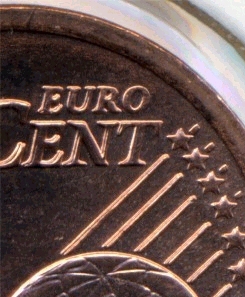
I saw this 2006 2 cent Euro coin on eBay. The seller photos were just OK -- but I thought it looked promising and decided to take a chance. In fact, I'd hoped the coin might turn out to be double struck. But now that I have it in hand - it appears to be a doubled die. Although not as impressive as the 2004 J 5 cent Euro shown earlier in this post, this one isn't too bad either. So what do you think? DD or something else?
http://www.idsimis.com/photos2/euro2006-a.jpg
http://www.idsimis.com/photos2/euro2006-b.jpg
In addition to the light doubling on the rays, note the faint doubling of the upper point of the star (to the left of the right-most star).
http://www.idsimis.com/photos2/euro2006-c.jpg
http://www.idsimis.com/photos2/euro2006-d.jpg
http://www.idsimis.com/photos2/euro2006-e.jpg
http://www.idsimis.com/photos2/euro2006-f.jpg
wavysteps
05-25-2008, 06:43 PM
At first it would seem to be double struck, however, since you did not mention that the obverse had any doubling, I sort of ruled that out. Unless, the second strike completely obliterated the first strike on the obverse and left a partial image of the first strike on the reverse. In that case, you may want to check the obverse very carefully to see if there is any evidence of another strike
That may leave a die related anomaly. Looking at the secondary image to the primary image, I just can not make myself think doubled die. To see such a strong secondary image in the word CENT and nothing in EURO just does not fit into the doubled die scenario. Then there is the offset angle between the secondary to primary image, best seen on the word CENT. Again, this does not normally happen on a doubled die. So, that would effectively rule that out also.
More than likely it is a double struck coin, however, it should be examined closely by someone of Mike Diamond's caliber.
BJ Neff
diamond
05-25-2008, 06:50 PM
It's certainly perculiar looking. Certain elements, like the rays and stars look like a doubled die. Other elements more closely resemble a double-strike. I'm wondering if it's a counterclash that is affecting the entire surface. Feel free to send it to me for a closer look. -- Mike
russellhome
05-25-2008, 07:55 PM
Thanks for weighing in Mike and BJ. I'm glad you found this coin as interesting as I did. The seller photos only showed fuzzy close-ups of 2 areas of the coin - and from what I saw in them, I thought there was a chance it was double struck. But it does not appear to be. There is no trace of doubling on the flip side of the coin. The rims are very odd - with a groove all the way around (like a pulley). But I think this is normal.
The doubling is all very light. It took a lot of work with the lighting angle to get some of it caputured in a photo. As you can tell from the photos, the heaviest area is around the C of cent, and in the other letters of CENT it fades out as you go toward the rim. To me, it does not look squished or flattened out, like on that Malaysian 20 Sen double struck coin I posted.
After seeing the coin, my thought was that it was 1) an aborted light hubbing - with the die possibly being removed, examined, and reinserted with slight rotation before the final hubbing(s) -- or -- 2) Some rough treatment on the part of the mint workers - perhaps slamming the die and hub together hard enough to leave an impression while setting up the press. I would assume a slight convex shape to the blank die would explain why a light hubbing (or clash) would have doubled elements that fade toward the rim.
Anyway - that's my 2 Euro cents on the matter. Mike - I'd be happy to send it in for a professional examination.
diamond
05-25-2008, 08:06 PM
I look forward to seeing it. If it is a counterclash, it will be the most extensive example by far on any coin.
russellhome
05-25-2008, 08:12 PM
Mike
Exactly what is a counterclash? I did a little searching on the web and found it mentioned in your MD document. But I could not find a definition.
diamond
05-25-2008, 08:26 PM
A counterclash occurs in the following sequence:
1. The die strikes a hard piece of metal that may be derived from a broken die, feeder finger, collar, or foreign source.
2. The struck object now has a raised design on it.
3. The struck object shifts position in the striking chamber.
4. The struck object is struck again. This transfers raised design elements on the object back to the die face (generally the field) in the form of incuse, mirror-image design elements.
5. Each coin struck by the die afterward carries raised, normally-oriented design elements in odd locations.
Earlier examples include two 1983 cents, a 1969-S cent, a 2000-P Sacagawea dollar, and the September 1999 Canadian "four faces" quarter.
russellhome
05-28-2008, 06:43 PM
The doubling on this coin is odd and it may appear to be going in different directions. I wanted to check to see if the doubling is consistent with a simple on-center rotation. So - with the magic of transparent overlays...
http://www.idsimis.com/photos2/euro2006-g2.jpg
I already sent the coin to Mike D for examination - so the only photo I had to use with the overlay was not perfectly centered over the coin. So the results may be skewed somewhat. But based on what I see, the areas of light doubing on this coin all seem to be consistent with a slight rotation of the design. The word CENT gets closer to the rim from left to right -- and the spread in the doubling increases accordingly.
Had both the regular and doubled elements on this coin been of equal depth - this would have been an awesome doubled die. I look forward to hearing what Mike has to say after his exam.
diamond
05-28-2008, 08:29 PM
I just picked up another, seemingly identical specimen. That would establish that this is a die issue and not a striking error.
wavysteps
05-28-2008, 11:22 PM
If they are the same, I would agree that it is a die issue, which would still leave the counter brockage on the table.
Of course, it would help tremendously if we knew what type hubbing system that the Euros are being made with. That might be an impossible task though with all the countries involved in there making.
BJ Neff
diamond
05-28-2008, 11:37 PM
Counterclash, not counterbrockage. A counterbrockage is a striking error. A counterclash is a die error.
wavysteps
05-28-2008, 11:40 PM
Your right Mike, it is a counter clash. I shouldn't be done these things late at night (LOL).
BJ Neff
russellhome
05-29-2008, 02:08 PM
... Of course, it would help tremendously if we knew what type hubbing system that the Euros are being made with. That might be an impossible task though with all the countries involved in there making.
BJ Neff
I did a little searching on the web last night to see if I could find any information about the San Marino mint. I didn't find much. I think it would help if I knew italian.
One thing I did learn was a better understanding of the meaning of 'ELF INC.' -- a phrase in fine print on the obverse of this coin. When I first saw it, I thought it meant that some private company minted the Euro coins for San Marino. Turns out that "ELF" is the engraver initials and "INC." is an italian abbreviation for "engraver". Shows you how much I know about Euro coinage.
f6tornado
05-30-2008, 01:29 AM
COUNTERFEIT AUSTRIA 1780 (RESTRIKE) 1 THALER DDO/TDR. I have attached four PICS.
wavysteps
05-30-2008, 09:50 AM
Very nice pictures and thanks for that post.
BJ Neff
diamond
05-30-2008, 11:37 PM
Your right Mike, it is a counter clash. I shouldn't be done these things late at night (LOL).
BJ Neff
After close inspection I've come to the conclusion that this is probably a doubled die after all. I suspect that the weak, incomplete, but strongly rotated design is due to a light impact of the hub against the die AFTER normal hubbing was completed. This was presumably accidental.
The reasons it's unlikely to be a counterclash are as follows:
1. Most counterclashes also feature erratic die damage, although there some notable exceptions. This coin shows no erratic die damage.
2. Every counterclash I've seen shows at least some lateral movement. This coin shows only rotation, as Kenneth's overlay demonstrated.
3. No other counterclash even approaches the size of this one. It's hard to fathom a hard object as large as the die and, presumably, as round as the die face intruding into the striking chamber.
While I can't completely discount the counterclash scenario, I have to apply Occam's Razor and go with the far more plausible doubled die scenario.
wavysteps
05-31-2008, 12:58 PM
Mike and Ken,
While I like the counter die clash scenario better, I can also fit a possible cause to an action that would make this a doubled die.
Ken's idea of workers being careless with the hub and die and making contact with the two may not be far from the truth. In order for this semi-impressed doubled die to be made, I think that we must look at it as post hubbing or occurring after the hubbing had been completed.
I am not to sure what type of mechanism actually lifts the hubbing Assembly from the die face when the die is finished and the pressure relieved, however, failure of that device, whether manually or mechanically, may allow the hub and its collar to drop onto the die face. While this would impart some damage to the die face, in the form of design elements from the high points in the hub, the impression would not be that deep (the weight of the collar and the hub + the distance traveled to the die). Also take into consideration that neither surface of the die or the hub is flat and also may have a slight amount of distortion from the residual thermal energy produced by the hubbing process; this would account for the partial design transfer.
Of course, this would open the door for a new Class of doubled die, Class IX or X, which would be defined as; "A die that was hubbed normally the first time, but through mechanical failure was weakly hubbed a second time".
Anyway, one of the three of us (or a collaborated article) should write something about this unique die. I do think that it is worthy of that consideration.
BJ Neff
diamond
05-31-2008, 07:17 PM
I think it's well worth an article. I hope you or Kenneth will consider being lead author. It would also be worth scrutinizing other doubled dies in your collections because some may fall into this category. Maybe that 1872 dime with the incomplete 170 degree rotated doubled die falls into this category.
I don't know if a new class of doubled die is necessary or desirable. None of the existing classes specifies in what order the two impressions are made. I think they accomodate any order. But I'll let the variety gurus hash it out. :)
BIM Mania
05-31-2008, 11:07 PM
Great thread on the 2 Euro cent guys.
Thanks for posting your progress!
f6tornado
06-02-2008, 01:11 AM
It looks like a doubled die to me. I was also bidding on the same coin as you did :). I have heared of other euro doubled dies comming from the Rome mint on Italian Euro coins as per Brian Raines told me he found a few. Very nice looing doubled die.
russellhome
07-10-2008, 06:18 PM
This was another eBay find for just a few bucks. It looks to me like a repunched digit on the date (the last 9). There is also an "E" that may also show signs of being repunched - but it may also be die deterioration. I cannot Tell.
http://www.idsimis.com/photos2/bel_1929-1.jpg
http://www.idsimis.com/photos2/bel_1929-2.jpg
http://www.idsimis.com/photos2/bel_1929-3.jpg
It is nothing major. But I liked it.
diamond
07-10-2008, 07:57 PM
The "9" is definitely repunched, Kenneth. The "E" may also be repunched. However, it seems that the lower serif of the "D" to the right of it may be split, which could point to a doubled die. Then again, maybe it was repunched, too.
russellhome
07-10-2008, 10:39 PM
Thanks for the comments Mike. I know the practice of punching out design elements died out a long time ago in US coinage -- but who knows how long it was practiced elsewhere?
One thing I found curious was how thin the bead of metal is on the lighter repunching of he "9". It does not seem like the punch of the finished "9" digit could have made that mark. It is almost like they used 2 different punches - one with a thin design to set deep and the second with the thick "9" to punch over the original punch. The trouble was they didn't punch in the same place. This is all speculation - of course. But trying to figure out what happened is 1/2 the fun.
diamond
07-11-2008, 12:36 AM
While a different punch may have been used, you must remember that most repunched mintmarks on US coins are also a lot smaller and thinner than the definitive mintmark, even though the same punch is used. That's because the vertical cross-sectional profile of the letter punch tapers toward the tip. A shallow penetration of that tip into the die face will leave a small, thin letter.
russellhome
12-08-2008, 09:43 PM
Another eBay find...
A 1923 D 200 Mark German (Weimar Republic) Doubled Die
I'm not even sure if this is technically a coin. It was minted during the hyper inflation that occurred in Germany from 1921 to 1923 and was pretty much worthless the day it was minted. It is the size of a quarter, as thin as a dime, and made out of aluminum. It is of worse quality than a 'Chuck-E-Cheese' token. There may be a million of these floating around, but it was a great doubled die and I just had to add it to my foreign DV collection.
http://www.idsimis.com/photos2/ger200mark1.jpg
The left side has the least amount of spread and it gets stronger moving clock-wise around the coin.
http://www.idsimis.com/photos2/ger200mark2.jpg
The spread is heavier at 12:00 o'clock. Note the split in the bird beak.
http://www.idsimis.com/photos2/ger200mark3.jpg
The spread on the right is just plain wild. To add to the confusion, it appears to have mechanical/strike doubling in addition to being a true hub doubled die.
http://www.idsimis.com/photos2/ger200mark4.jpg
The bottom is back to showing less of a spread. Note the notch in the star and the the doubled claw tips.
http://www.idsimis.com/photos2/ger200mark5.jpg
If you think our current economic times are bad -- just look back in history to see what happens when a country decides to pay off its debt by simply printing more money. By the fall of 1923, the German Mark was pretty much worthless. It would take several 200 Mark coins just to buy a postage stamp. Notes were issued in excess of a billion marks and local cities started printing their own local money in an attempt to control the chaos. It was during this time that the seeds of fascism began to take root.
http://www.idsimis.com/photos2/ger200marks.jpg
I wonder what 1,001,100,201.25 Marks could buy in 1923. Probably not much.
wavysteps
12-09-2008, 10:11 AM
Great looking doubled die Ken. I imagine that a lot of these were lost or melted down for use in other purposes since it was not worth anything.
BJ Neff
vBulletin® v3.7.2, Copyright ©2000-2009, Jelsoft Enterprises Ltd.